
SketchUp Before The Final Render: Grey Boxing and Modelling for Thinking
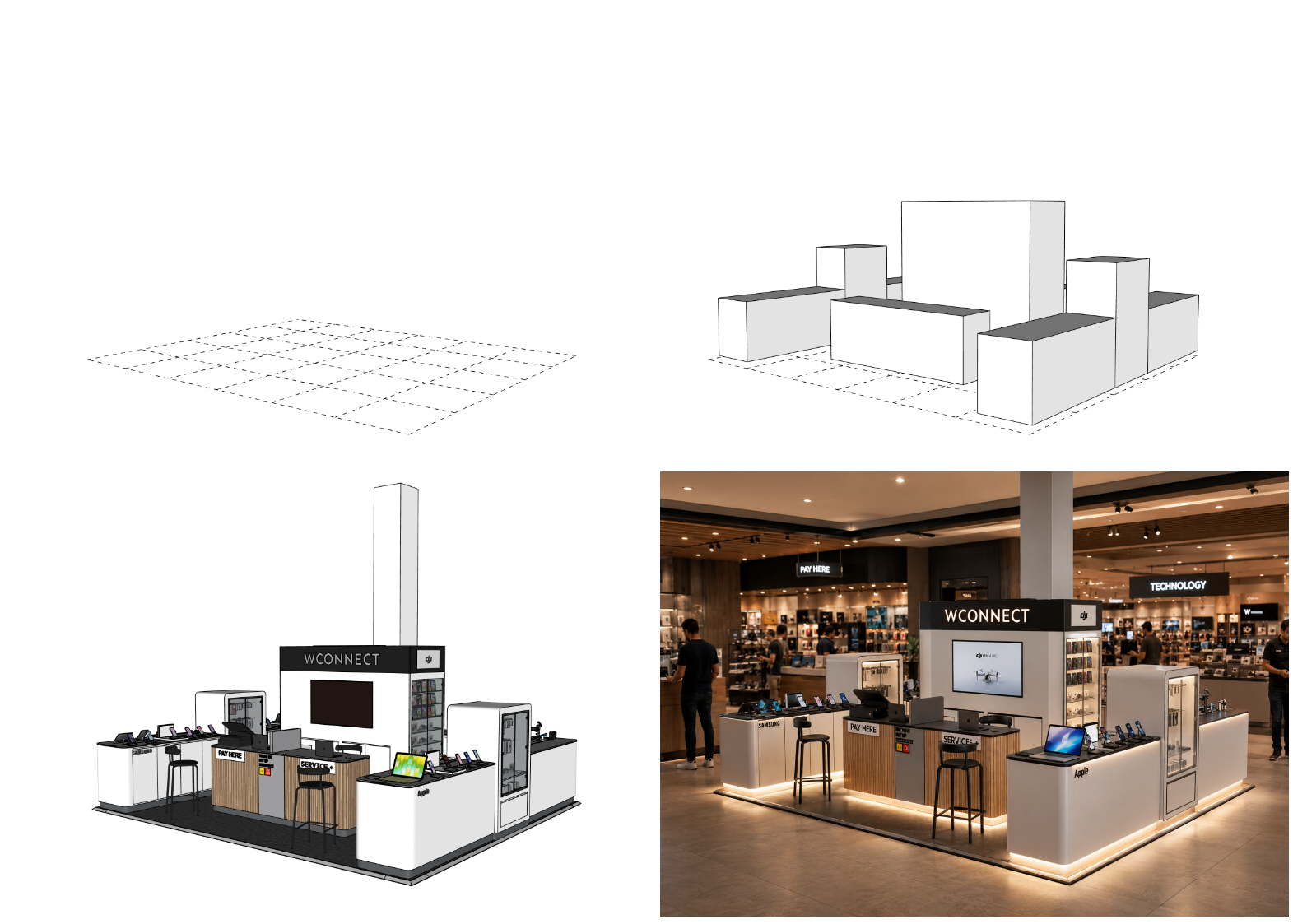
Grey-boxing in SketchUp: modelling to think, before anything becomes polished.
1. What role does SketchUp play before anything becomes polished?
SketchUp is a very simple surface modelling tool. We draw mostly with the line tool, the rectangle tool, and the circle tool and pay attention to what's missing from that list: the triangle.
SketchUp is not a triangulation meshing tool. It values rectangles over triangles, and that has a connotation for organic modelling, where everything is generally triangulated and sub-surface divided which is exactly what SketchUp is trying not to do. SketchUp thinks in squares, rectangles, and straight shapes.
Is that problematic? No. But it needs to be mentioned, because it tells you what the tool is for.
Think of grey boxing like the first sketch on your notepad the Moleskine, the Palomino Blackwing 602. Twice the speed, half the pressure. In that sketch you're not trying to draw something as detailed and anchored to reality as possible. You're trying to get the balance and nuance of the thing right. You are facilitating a process of thinking by visualising your thought experimenting with your thinking through the act of visualisation.
SketchUp gives you a platform to do the same thing in 3D. I'm not discrediting the fact that SketchUp handles accurate modelling, detailed manufacturing, 3D printing, municipal submission drawings, or rendering all of that is possible. But the basics of drawing in SketchUp are so elementary, free, and simple that the honest comparison is sketching.
Before anything becomes polished, we want to draw to capture essence. To explore. Not to be fussy about niggly finishes, colouring, and fine texturing. We want to rough-model. And rough modelling has a name: grey boxing.
2. Why is grey boxing still valuable?
Grey boxing comes from the game industry. Think of organisations like Epic Games: game engine developers first, game developers second. Their engines started with a black world in which you drew grey shapes, and the technique kept the name.
What the game designers identified is that it's much easier to model from the outside in. Modelling from the outside in is sculpting. Think of Michelangelo and the David: he took a block of marble and chiselled David out of it. The famous saying is that David was always in the stone Michelangelo knew it, and all he had to do was reveal him. He removed material to reveal the figure.
Game design also lives under constraints you watch your polygon count so the game runs on an average console. So the level designer starts with the path the gamer will walk. Call it LOD 100, the lowest level of detail: one continuous long grey box think Temple Run inside which every obstacle and challenge will happen. Then, at what we could call LOD 200, the box gains steps, pavement, blocks, walls, roofs, doorways, windows: the contextual modelling that describes how the gamer plays through the environment. And only then do the fine artists move in the door frame that fits the door opening, the window in the window opening, the tiles on the roof.
Now translate that to retail, architecture, or event design. An exhibition stand of 5 × 5 metres. A retail store of 10 × 20. An experiential stage for a music festival. The space has a maximum size so draw one big grey box and carve, inside it, the environment the artist plays on, the customer walks through, the visitor experiences.
In retail, the maximum dimension is simply the white box: the empty concrete shell with perhaps some glazing, a front door, and a rough open ceiling left by the previous tenant. We know its dimensions, and we draw our grey box design inside it virtually. (You could scan the white box first a Gaussian splat to confirm the real shell matches the architectural drawings. But we'll keep that for another blog.)
3. How do you use rough models to make decisions faster?
Start with rudimentary questions. How many freestanding units, display tables, point-of-sale counters, change rooms, and wall-mounted fixtures does the client want? Or even more basic: how many zones does the store need? Men, women, children, dried goods, food produce, homeware, cooking.
Then give each zone a footprint box. The women's section gets 30 square metres, homeware 20, the men's section 20 and now let's play Tetris with those blocks inside the white box. Ladies and men's on the left of the central aisle; homeware, dry goods, and cooking on the right. Change rooms at the far back with the point of sale or between the women's and men's sections. Move the pieces. Argue. Move them again.
In a draft model, these decisions happen quickly. And by making them together, everyone from the ground up client included has had a part in the thinking of how the store was laid out. There's inclusivity and ownership in the decision-making, instead of the client feeling left out of the process until we reveal, in big dramatic fashion, what we designed on their behalf.
This is also why we resist detail at this stage. Spend too long on the fine detail of one fixture and someone in the room will hyperfixate on that one item. That's not an absolute rule if the client owns a chandelier that will hang centrally in the store, by all means drop the detailed 3D Warehouse model into the grey box, because it's a fixed element that will always be there. But even that can distract from the real conversation: the floor-standing tables in combination with the line of sight from the point of sale to the change rooms because the staff at the counter need to keep an eye on the change rooms to prevent theft. That's the level the grey box keeps you honest at.
4. What should juniors learn about modelling for thinking, not just presentation?
At the grey box stage, the model's job is to give us room to think. This is the point to question our own assumptions and the client's, and the mall management team's, and those of the store manager who ran the previous location. We operate in the space, make decisions in the modelling process, and think out loud together.
What we do not do is present the first grey box as Option One, the obvious, in-your-face, direct solution. We are modelling for thinking, which lets us present our thinking to the client not just a final, conceptually rendered image. We show the numerous grey boxing variations we've created, each time highlighting the key difference for the decision-makers, whether that's a single owner or a multi-stakeholder investor group.
What we demonstrate is that designers draw for thinking, not only to reach a conclusion. We draw for exploration. And yes the client is paying for that. They're not paying us to go to the store and buy milk. Nothing wrong with buying milk: you walk to the cold section, weigh up full cream, low fat, no fat, and make your choice. But here there is no milk. There is no cold section. You're walking into an empty store, deciding whether there will even be milk in it thinking through every scenario of what the customer comes to buy, how they want to see it presented, and how everything around it should be laid out. That thinking has value. That thinking is the essence of the design process.
It's where the designer enters a state of flow: weighing the client's preferences and initial gut feeling against everything else the designer understands, letting creative exploration run without borders or stopping forces and then channelling it into a clear direction, challenging that direction, and accelerating into the full flow of the process toward a conclusion
.
5. How does this connect to D5, AI, or scanning later in the process?
There comes a step in the process where you want to explore different qualities of lighting, different textures, different stylistic choices. This is where the grey box pays off again.
Using D5 or AI image generation, the grey box without any detailing can quickly gain three or four layers of stylistic detail. You don't end up drawing the baroque-style shelving by hand. You tell the AI: the boxes labelled A or the boxes in blue need to be translated into a baroque style. Or made completely out of wood. Or out of steel plumbing pipe. The AI environment lets us explore different styles for executing the boxes before we add the detail in person.
It's a wonderful connection: the exploratory work of laying out the space the flow the consumer navigates between objects is ours; the deep-dive into stylistic observation can lean on AI, mapping styles over or complementing the grey boxing we've done. The skeleton we've drawn acts as the framework for the style to be painted over: in very different styles, in combinations, in different balances and weightings. And with it, we can present a client with the early stages of our thinking and the final stages of our thinking.
The grey box is the thought. The render is just how the thought gets dressed.
For questions, email info@studiojdb.com.
Part 7, Digital Twins For Retail Design. Part 5, Placing SketchUp Models Inside Real Scanned Environments.