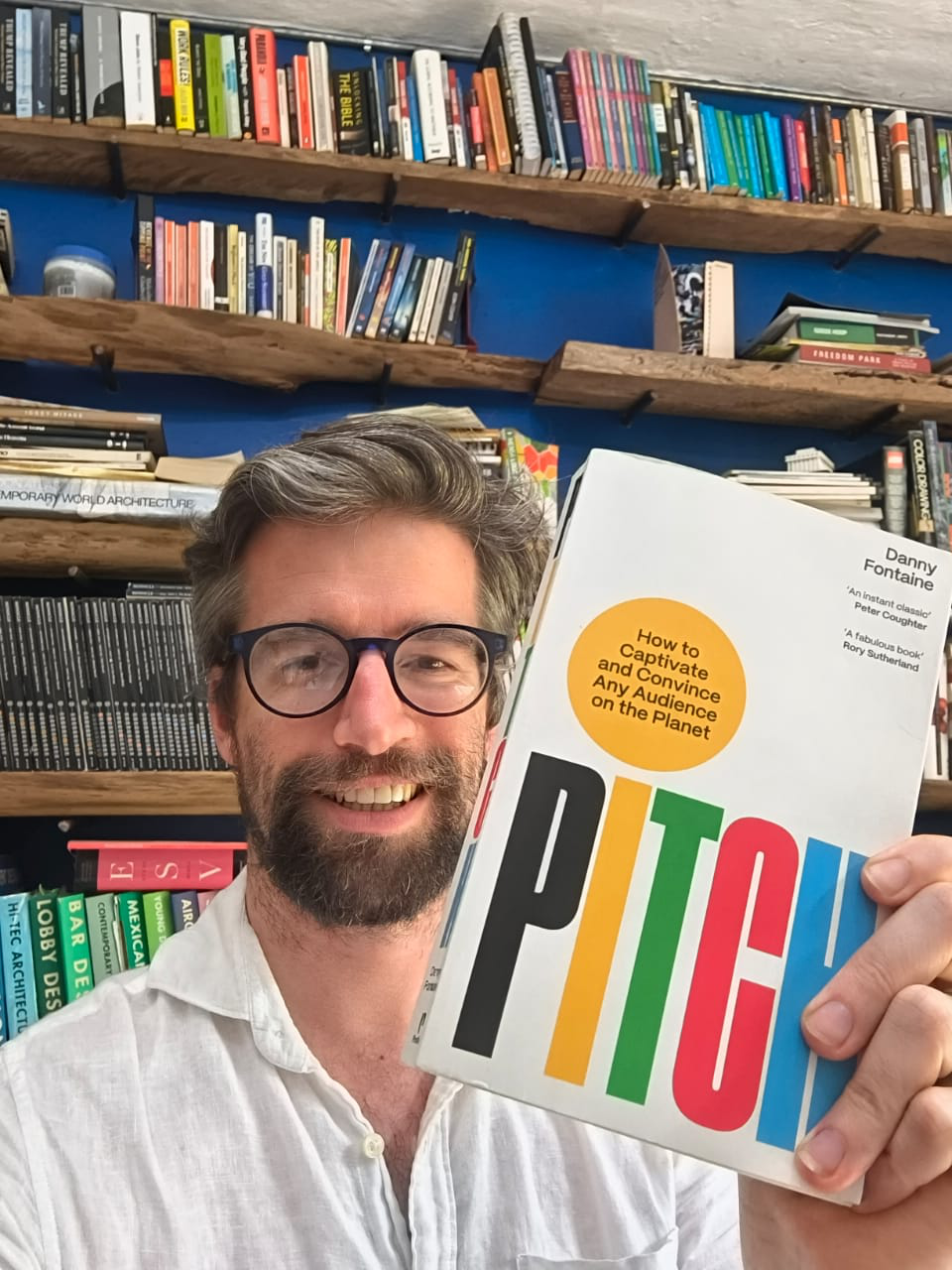
A Book Pitch at an Airport
I love a good airport magazine stand.
It’s one of the few retail environments designed for people who move internationally, frequently, and usually with enough time on their hands to browse like it’s a hobby. The selection is always broader than your neighbourhood bookdealer back in a gated South African suburb.
So there I am, wandering past Wired, Monocle, and Time, when I spot the business book stand.
And like wine, I enjoy the ritual: find an interesting spine, pull it out, check if the cover is just “pretty” or if there’s actually something serious inside.
That’s when I see it.
A bright, colourful spine with one loud word stretched across it like a billboard:
PITCH.
I flip it over. Same bold letters on the cover. A short explanation on the back. And then, like a little credibility wink from the universe, Rory Sutherland has a quote on it.
“A fabulous book,” he says.
I think: I like that guy’s YouTube videos.
I hover for a moment. Consider it. Then do what every disciplined traveller does when faced with temptation:
“Nah.”
Back on the shelf. Off to the gate. Minimalism. Virtue. Etc.
A Few Weeks Later: The Book Finds Me Again
Another flight. Same airport. Same shop.
This time, I’m not casually browsing, I’m hunting.
I can’t find it.
I get irrationally annoyed (as one does when the universe doesn’t cooperate with a decision you didn’t make earlier). I storm off to Woolworths, grab a cortado, go through security… and there it is again, same bookstore, but now in departures.
Turns out the book didn’t disappear.
It was just waiting for me to commit.
I grab it.
And I realise something else: sometimes you should just buy the thing you want instead of quietly hoping someone will read your mind at Christmas. You might get the Lindt. You might get the Glenfiddich. But the book? The cool book? That’s on you.
So yes - this year I gifted myself PITCH.
Reading It: The Strange Joy of Pitching
Once the Christmas noise settled, I finally opened it.
The first pitch examples are hilarious—like, laugh-out-loud, “how did someone actually say that” hilarious. And immediately I felt it: that old excitement.
Not the corporate pitch-deck grind.
The creative pitch energy.
The thrill of the chase.
The opportunity to explore something new.
The chance to take a weird, half-formed thought and sharpen it into something that could actually change a room.
As I worked through more examples, I got a renewed sense of creativity around pitching—the kind I fell into at agencies like Jawbone, where the pitch process can become its own kind of studio discipline: pressure + constraint + imagination.
Then the Other Book Walks Into the Room
But in the back of my mind, another title kept tapping me on the shoulder:
Win Without Pitching Manifesto.
If you’ve spent any time with me, you know this: thinking is my favourite pastime.
And pitching, let’s be honest, can start to feel like thinking for free.
Now, I’m going to say something slightly dangerous for someone who does enjoy pitching:
I really do enjoy pitching.
But I also hate losing.
And the idea of winning without pitching has always had a certain allure—less performance, more partnership. Less audition, more alignment.
Because not every client wants ideas first.
Some want certainty first.
Some want a steadfast team, a familiar face, someone who’s walked alongside them long enough to get it—and who doesn’t need to prove it again every quarter with a deck.
So… Pitching vs No Pitching?
Here’s where I’m landing right now:
Pitching is for exploration.
It’s a tool for:
entering new territory
testing new categories
pushing conceptual range
forcing clarity under pressure
discovering what the studio is capable of next
“No pitching” is for compounding trust.
It’s a tool for:
deeper partnership
better margins
better process
less performative work
long-term outcomes that don’t rely on novelty
They’re not enemies.
They’re two different vehicles.
One is a rally car.
The other is a well-built ship.
When I’d Choose Which
I’d pitch when:
the brief opens a new world I want to explore
the work demands a strong concept (not just execution)
the client values thinking and originality
the opportunity is worth the risk of “thinking for free”
I’d avoid pitching when:
the client is buying safety, not imagination
the selection process is clearly price-led
the pitch is a theatre ritual with a foregone conclusion
the relationship would be better built through smaller “paid proof” steps
The Punchline
I still see reasons not to pitch.
But increasingly, I find myself drawn to the adventure of it—the creative sprint, the conceptual workout, the “what if we went there?” feeling.
Because even if you don’t win the pitch…
A good pitch makes you sharper.
And a sharper studio doesn’t just win work.
It builds a body of ideas worth believing in.